table

Home VE O2U/O3U SU SBU SB2U OS2U TBU V-173 F4U F5U F6U F7U A2U F8U A-7 C-142 Missiles V Numbers Other Vought
Click on designations above to see relevant posts
Showing posts with label Other Vought. Show all posts

Saturday, May 21, 2022

ADAM VTOL Tactical Transport

 In February 1960, Chance Vought and Pratt and Whitney completed an Air Force study under study requirement SR-175 for a VTOL logistics and support transport that was to be operational in the 1965-70 time frame. 

The proposed aircraft was to be powered by four P&W JT12A-7 engines (SR-175 ADAM VTOL Military Transport.jpg). General Dimensions: Length 53ft, Span 43ft, Height 19ft 2in. Max gross weight was targeted at 25,100lbs. 


The operating cost was pitched as favorably comparable to the Lockheed Electra, Jet Star and Convair 540. 

In addition to the targeted VTOL aircraft of the study a STOL version of the ADAM was included (SR-175 ADAM STOL Military Transport Swing Tail.jpg). 


Sunday, November 22, 2020


Advanced Interceptor

Vought Aeronautics Division heard of interest in hypersonic interceptor aircraft in March 1968. The team went to work on an Advanced Interceptor (AI) study. Driven by Required Operational Capability (ROC) for Advanced Manned Interceptor, (LAO-3119 10 July 1968) from the USAF and a composite cycle engine evaluation study (Request for Proposal No. F33625-69-12-1453, Exhibit “A”. Statement of Work 4 October 1968) the team went to work.

VAD had already proposed a Universal Hypersonic Test Vehicle (UHTV) program earlier in the year. With a further definition of the mission for the AMI the team was able to apply their previous work on the UVHT to the new requirements.

Two of the goals for the project were to formulate aerodynamic design concepts and evaluation of candidate propulsion cycles. Five mission profiles were studies which created 13 different airplane configurations that filtered down to three refined base line configurations.

VAD viewed the mission definition of the AI as tenuous at best. The reason for that view were the different projected requirements of the USAF and SUN in purpose and complexity.

ZAP

The first mission was described as the ZAP. It consisted of the following:

1.       Outbound leg of acceleration to Mach 4.5 while climbing to cruise altitude and cruise out to a range of 500 NM.

2.       A 3g, power-off decelerating turn to Mach 3.0 at 80,000 ft.

3.       Followed by a constant altitude, constant Mach number turn at thrust limited normal load factor not to exceed 3g

4.       Engagement segment of 250 NM to inspect and attack the intercepted target.

5.       Finally, a cruise and descent to sea level with a twenty minute loiter capability at Mach 0.3.

ZORCH, SNAKE, ZIP and ESCORT were the names of the other operational mission profiles. Most notable differences were in the ZORCH and SNAKE that required a 1500 NM outbound leg.

Armament

The mission profiles assumed six missiles with no specifics on missile type current or projected. For the purposes of the project six missiles totaling 2000lbs and 1000lbs for a 30 mm internal gun and ammunition filled the bill. There was one missile from a McDonnell study called the “Raytheon 400”. The missile featured a compact arrangement which made it a good candidate for internal stowage.

The ZORCH and SNAKE profiles necessitated a larger aircraft due to the range; radar needs and second crew member to operate the radar. Designs included external conformal phased radar antennas but also permitted an interplanar array of 36 in diameter.

Crew Accommodations

There was a requirement for forward visibility equivalent to current fighters, which was a challenge with the heating challenges and high angles of attack for landing which led to tilting nose arrangements. The crew also had to be provided and escape capsule due to the high speeds. A closed-circuit video display was later proposed to eliminate the complexity of the tilting nose.

Engine Types

They engine types evaluated were fascinating in name as well as function: Supercharged Ejector Ramjet (SERJ), Plenum Burning Turbofan, Turbojet, Turboramjet, Rocket Augmented Turboramjet, Airturborocket, Turbofanramjet, Supersonic Inflow Turbofanramjet, Turboramjet-Stoichiometric Core, Afterburning Turbojet and finally Combination, Rocket, Ramjet, Turbofan,

Recommendations

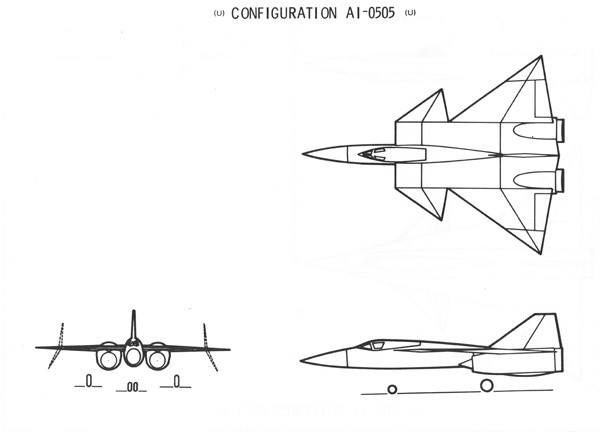
In the end the VAD team developed two base line aircraft designs the A-105 and the A-505. The recommendation also included a design maximum speed of Mach 4.5 due to the constraints of fuel selection and construction materials available at the time. For an engine they stated that the Supercharged Ejector Ramjet (SERJ) and the Turbofanramjet (TFRJ) were the most promising.


AI-105K

Further visuals on the AI-105K

Production break down drawing of an AI-101


Tuesday, June 20, 2017

Happy 100th Chance Vought Aircraft

June 18, 1917 was the founding day of the Lewis and Vought Corporation in New York City.
June 21st a special celebration was held in Dallas, Texas to commemorate the occasion sponsored by the Vought Heritage Foundation & Retiree Club.


Sunday, August 28, 2016

LSWT - Low Speed Wind Tunnel

In March 1955, Vought dedicated Facility 107 at the Naval Weapons Industrial Reserve Plant Dallas. This was the beginning of the Low Speed Wind Tunnel facility for Vought. 

Aerial view of the LSWL and Hover facilities at NWRIP Dallas just after the 1965 enhancements. (VAHF Collection)

The 1965 additions to the wind tunnel included outdoor and indoor hover facilities. At the time ADAM, C-142 and a whole host of VTOL/STOL designs were begin tested at Dallas.

Outdoor hover facility as part of the LSWT. (VAHF Collection)

The facility was modified again in 1971. The facility has run tests on Vought products and designs from the Regulus, Crusader, Corsair II. Other contracted work included: football stadiums, cars, laser bomb seekers, missiles, parachutes and even the space shuttle.

Fan unit for the LSWT (VAHF Collection)


The following images are a sampling of projects that were tested in the LSWT.

TFX Weapons Integration  (VAHF Collection)
 
B-52 Missile Integration  (VAHF Collection)

Tilt Rotor  (VAHF Collection)

Retractable Roof Sports Stadium  (VAHF Collection)

ACES II Ejection Seat?  (VAHF Collection)

RC-130S Battlefield Illumination Airborne System (BIAS)  (VAHF Collection)

NASA Shuttle Test  (VAHF Collection)

NASA Shuttle Test  (VAHF Collection)

Lockheed Star Clipper  (VAHF Collection)


Monday, February 29, 2016

ADAM (Air Deflection and Modulation)

     Sitting here wondering if there is any interest in doing a series of posts on the ADAM designs.

Here are a couple of drawings and a photo of models (courtesy VAHF Archives) that look interesting:


Sunday, January 25, 2015

Did you know?

Vought built the aft fuselage of the B-1B Lancer? The aft intermediate and aft sections were produced in Texas and shipped to Palmdale, California for assembly on the B-1Bs. Basically aft of the wing box with the exception of the tail cone, vertical and horizontal stabilizers were constructed by Vought.

Here are some images of an aft intermediate section being unloaded from Super Guppy N940NS at Palmdale. This is the first delivery to support the B-1B program. Notice the gathering in the hangar including a film crew that are visible in some of the photos.

Super Guppy in position


Cargo section open on the Super Guppy and the loading platform moved into position


 The aft intermediate section of the B-1 is moving forward onto the platform


The aft intermediate section is completely on the platform.


 Nice side view of the after intermediate section on the platform


 Final view with the aft intermediate section preparing to be towed away from the Super Guppy.


It is not clear how many sections were transported by air. Rail was the economic, preferred method of transportation. There were specially designed rail cars for transporting the B-1 sections. I will gather some up for a later post. Vought's other subcontract work like S-3 Viking sections and 747/757/767 tail assemblies all ride the rail.

This was yet another example of an interesting payload carried by Super Guppy aircraft.
Photos from the VAHF Archives.